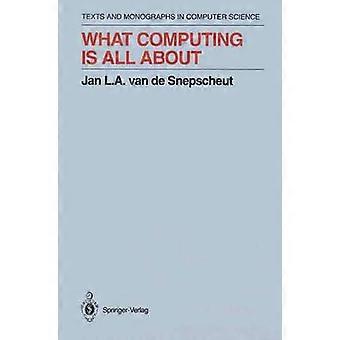
What Computing Is All About

PLN462.69
+ PLN31.99 Shipping

What Computing Is All About
  • Brand: Unbranded
Sold by:

What Computing Is All About

  • Brand: Unbranded

PLN462.69

In stock
+ PLN31.99 Shipping

14-Day Returns Policy

Sold by:

PLN462.69

In stock
+ PLN31.99 Shipping

14-Day Returns Policy

Payment methods:

Description

What Computing Is All About

1 What Is Computing All About? 1. - 2 Grammars 11. - 2. 1 Strings and Languages. - 2. 2 Grammars. - 2. 3 The Language Defined by a Grammar. - 2. 4 Bibliographic Notes. - 2. 5 Exercises. - 3 A Program Notation. - 3. 1 Introduction. - 3. 2 The Simple Statements. - 3. 3 The Conditional Statement. - 3. 4 The Iterative Statement. - 3. 5 Procedures. - 3. 6 Recursion. - 3. 7 Bibliographic Notes. - 3. 8 Exercises. - 4 Regular Expressions. - 4. 1 Right-Linear Grammars. - 4. 2 Transition Graphs. - 4. 3 Regular Expressions. - 4. 4 The Relation Between the Three Formalisms. - 4. 5 Equivalence Relations and Finite-State Automata. - 4. 6 Bridling Nondeterminism. - 4. 7 Bibliographic Notes. - 4. 8 Exercises. - 5 Integrated Circuits. - 5. 1 Semiconductor Physics. - 5. 2 Semiconductor Junctions. - 5. 3 MOS Transistors. - 5. 4 Combinational Circuits. - 5. 5 State-Holding Devices. - 5. 6 Sequential Circuits. - 5. 7 Variations. - 5. 8 Bibliographie Notes. - 5. 9 Exercises. - 6 Recursive Descent Parsing. - 6. 1 Top-Down Parsing. - 6. 2 Recursive Descent Parsing. - 6. 3 Limitations. - 6. 4 Lexical Analysis. - 6. 5 LR(k) Parsing. - 6. 6 Bibliographic Notes. - 6. 7 Exercises. - 7 The Halting Problem and Formal Proofs. - 7. 1 The Halting Problem. - 7. 2 Logic and Boolean Expressions. - 7. 3 Gödel's Incompleteness Result. - 7. 4 Cantor's Diagonal Argument. - 7. 5 Calculating with Boolean Expressions. - 7. 6 Formal and Informal Mathematics. - 7. 7 Bibliographic Notes. - 7. 8 Exercises. - 8 Some Programming Heuristics. - 8. 1 Omit a Conjunct. - 8. 2 Replace a Constant by a Variable. - 8. 3 Enlarge the Range of a Variable. - 8. 4 Reduce the Problem Size. - 8. 5 Random Examples. - 8. 6 Conclusion. - 8. 7 Bibliographic Notes. - 8. 8 Exercises. - 9 Efficiency of Programs. - 9. 1 A Lower Bound for Searching. - 9. 2 Analysis of Nested Loops. - 9. 3 The Constant Factor. - 9. 4 Conclusion. - 9. 5 Bibliographic Notes. - 9. 6Exercises. - 10 Functional Programming. - 10. 1 LISP. - 10. 2 Well-Founded Definitions. - 10. 3 More Examples of LISP Programs. - 10. 4 A LISP Interpreter Written in LISP. - 10. 5 A LISP Interpreter Written in Pascal. - 10. 6 Discussion. - 10. 7 Bibliographic Notes. - 10. 8 Exercises. - 11 Program Inversion. - 11. 1 Inversion of Programs. - 11. 2 Reversible Computations. - 11. 3 Circuits Built from Reversible Gates. - 11. 4 Reversible Gates Built from Billiard Balls. - 11. 5 DNA and Turing Machines. - 11. 6 Hot-Clock nMOS. - 11. 7 Bibliographic Notes. - 11. 8 Exercises. - 12 A Collection of Nice Algorithms. - 12. 1 Bresenham's Algorithm. - 12. 2 Computing the Transitive Closure. - 12. 3 Recording Equivalence Classes. - 12. 4 Minimization of Finite Automata. - 12. 5 Oil-Spread Algorithms. - 12. 6 Figure 6. - 12. 7 Huffman's Algorithm. - 12. 8 Bibliographic Notes. - 12. 9 Exercises. - 13 Concurrent Programs. - 13. 1 Mutual Exclusion. - 13. 2 A Subtle Mistake. - 13. 3 Communication via Channels. - 13. 4 Buffers. - 13. 5 Merging Two Streams. - 13. 6 Data Structures. - 13. 7 Matrix Multiplication. - 13. 8 Algorithms that Scale. - 13. 9 Bibliographic Notes. - 13. 10 Exercises. - 14 Implementation Issues: Compilation. - 14. 1 Translating from One Notation to Another. - 14. 2 Expressions. - 14. 3 Nomenclature. - 14. 4 Assignment Statement. - 14. 5 Parameters. - 14. 6 Flow of Control. - 14. 7 A Word About Big and Small. - 14. 8 Arrays. - 14. 9 Side Effects. - 14. 10 Peephole Optimization. - 14. 11 From Stack Machine to Register Machine. - 14. 12 Range Analysis. - 14. 13 Concurrency. - 14. 14 Assembly. - 14. 15 Bibliographic Notes. - 14. 16 Exercises. - 15 An Example of a Compiler. - 15. 1 The Program Notation Pascal-S. - 15. 2 The Stack Machine. - 15. 3 The Compiler. - 15. 4 Bootstrapping. - 15. 5 Bibliographic Notes. - 15. 6 Exercises. - 16 The Construction of a Processor. - 16. 1 ProcessorOrganization. - 16. 2 The ALU. - 16. 3 The Controller. - 16. 4 Multicomputers. - 16. 5 Bibliographic Notes. - 16. 6 Exercises. - A Answers to Some of the Exercises. - B Bibliography. Language: English
  • Brand: Unbranded
  • Category: Computing & Internet
  • Format: Paperback
  • Language: English
  • Publication Date: 2011/09/22
  • Publisher / Label: Springer
  • Fruugo ID: 337914159-741573649
  • ISBN: 9781461276395

Delivery

Dispatched within 4 days

  • STANDARD: PLN45.68 - Delivery between Mon 27 July 2026–Thu 30 July 2026

Shipping from United Kingdom.

Returns & Cancellations

Returns

We do our best to ensure that the products that you order are delivered to you in full and according to your specifications. However, should you receive an incomplete order, or items different from the ones you ordered, or there is some other reason why you are not satisfied with the order, you may return the order, or any products included in the order, and receive a full refund for the items.

View full return policy

Cancellations

You have the right to withdraw from your purchase within 14 days from receiving your order without giving a reason. To exercise your right easily, you can use the "Cancel my order" link in the footer of every page or within your Fruugo account under "Orders". Once you exercise your right to withdraw, we will send you an email acknowledgment. If your order has already been shipped by the retailer, we will provide you with the necessary return instructions to ensure your refund is processed promptly.

View full cancellation policy